

TRAINING
Welcome to the CYTISINICLINE Training & Resources section, where we aim to provide useful resources to support your understanding and use of Cytisinicline to help you as you work to support people on their journey to quit smoking.
Explore the available education and training resources:
- Coming soon! Product Information Videos - short videos outlining CYTISINICLINE and its clinical features and key prescribing information.

- Key Resources - a selection of key resources, including a quick-reference prescribing guide and patient dose card.
- Frequently Asked Questions - answers to frequently asked questions about Cytisinicline
For more information, contact Consilient Health here:

CYTISINICLINE PRODUCT INFORMATION VIDEOS
KEY Cytisinicline RESOURCES
Cytisinicline Prescribing Factsheet
An A4 quick reference guide covering key information for anyone recommending or prescribing Cytisinicline. Download a pdf here or contact us and we’ll send a printed version.
Cytisinicline Dosing Guide and Patient Leaflet
A leaflet for patients taking Cytisinicline with a
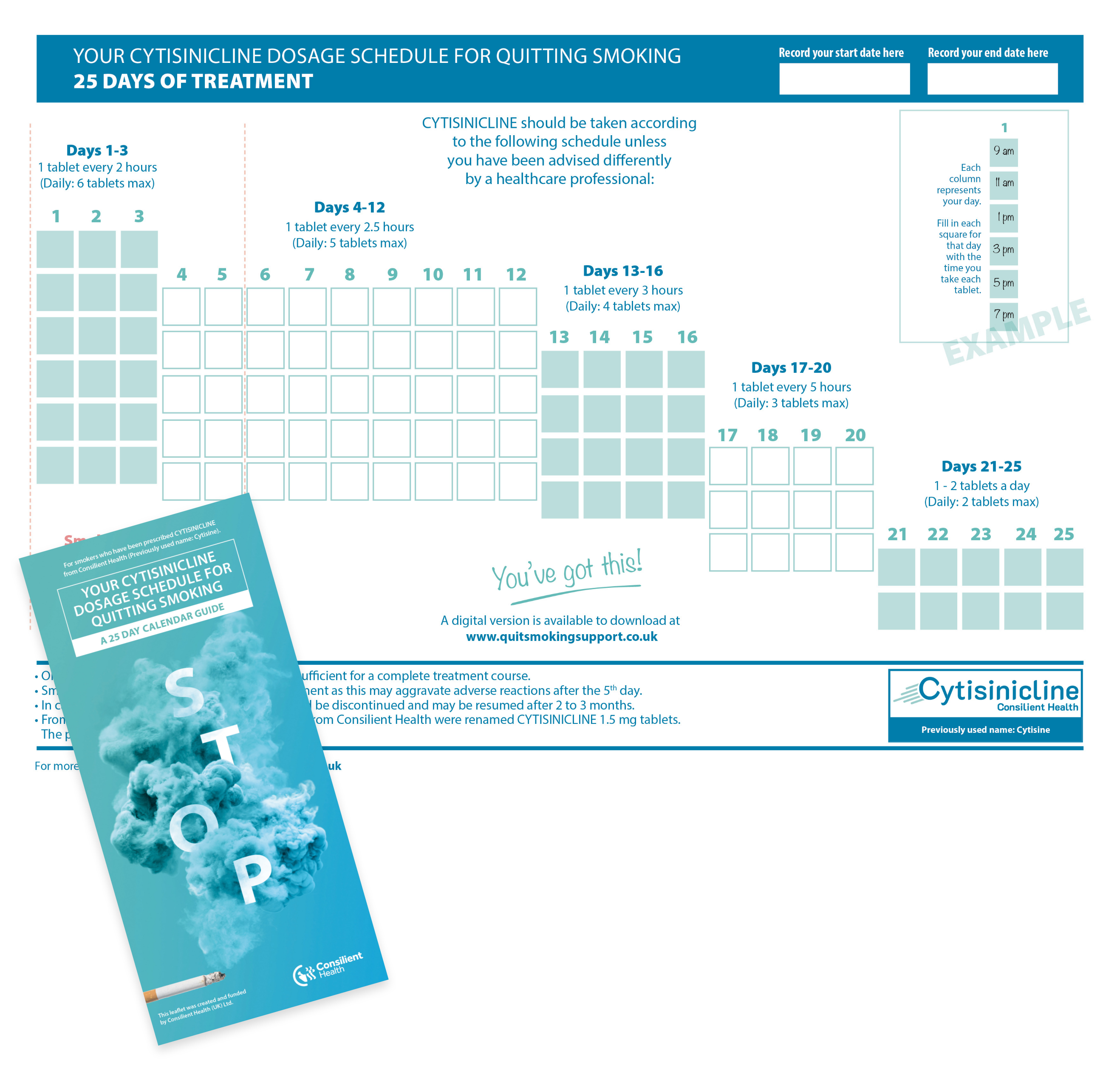
handy dosing table to help them track their treatment. Contact us to order printed copies or download a pdf here.
UPDATES

ASH webinar: Varenicline and Cytisine
ASH, an independent public health charity, ran a webinar on varenicline & Cytisinicline (Previously used name: Cytisine) on the 16th of December 2024. You can find a link to the webinar hosted on the ASH website, as well as a short summary below. Click here to watch the webinar -- On 16th December 2024, ASH hosted a Smokefree NHS Network online event on the smoking cessation medications varenicline and Cytisinicline (Previously used name: Cytisine). The webinar provided an overview of varenicline and Cytisinicline, a case study from Greater Manchester on their use in trusts and a summary of the NCSCT training materials and briefings on these medications. There were also presentations from the Specialist Pharmacy Service on Patient Group Directions and Fresh who are working with local authorities and pharmacy colleagues to develop a regional PGD Pharmacy supply service for varenicline & Cytisinicline, in the community. -- We would like to thank ASH for giving permission to share this link. Please note that ASH is an independent organisation and the inclusion of this link does not imply any endorsement or affiliation between Consilient Health and ASH.
Read more…
Cytisinicline now an option recommended by NICE!
NICE guideline NG209 has been updated to include Cytisinicline (Previously used name: Cytisine).¹ Cytisinicline has been classified as among the "more likely" interventions to result in successful quitting for UK smokers in the updated NICE NG209 guidelines.¹ The NICE Guidelines mandate that healthcare providers ensure Cytisinicline is made available to smokers as a treatment option alongside other current therapies. To read the full updated guidance Click here Cytisinicline, an effective treatment and supported by decades of use in Eastern Europe, is now endorsed by NICE giving healthcare professionals an additional option for smoking cessation1-4 1. NICE NG209. Tobacco: preventing uptake, promoting quitting and treating dependence. https://www.nice.org.uk/guidance/ng209 2. Cytisinicline Summary of Product Characteristics. https://www.medicines.org.uk/emc/product/15789/ 3. Prochaska JJ, Das S, Benowitz NL. Cytisine, the world's oldest smoking cessation aid. BMJ. 2013 Aug 23;347:f5198. doi: 10.1136/bmj.f5198. PMID: 23974638. 4. Karnieg T et al. Cytisine for smoking cessation. CMAJ: 2018 Cited at: https://www.cmaj.ca/content/190/19/e596
Read more…
AWMSG recommends Cytisinicline as an option for smoking cessation
Following a directed appraisal by All Wales Medicines Strategy Group, Cytisinicline (Previously used name: Cytisine) is recommended as an option for use within NHS Wales for smoking cessation and reduction of nicotine cravings in smokers who are willing to stop smoking. Click here to access
Read more…
RESOURCES

ASH webinar: Varenicline and Cytisine
This link does not imply any endorsement or affiliation with ASH.

Cytisinicline Dosing Guide and Patient Leaflet (Print)
Please find the Cytisinicline Dosing Guide and Patient Leaflet (Print).
Cytisinicline Dosing Guide and Patient Leaflet (Digital)
Please find the Cytisinicline Dosing Guide and Patient Leaflet (Digital).
NCSCT Commissioning Guidance
NCSCT Local Stop Smoking Services and support guidance, April 2024.
Cytisinicline Clinical Evidence Summary
Please find the Cytisinicline clinical evidence summary.
NCSCT Cytisinicline briefing
National Centre for Smoking Cessation and Training briefing on Cytisinicline.
Link to recent BTS guidance
BTS Medical management of inpatients with tobacco dependency, March 2024.
Cytisinicline Patient Information Leaflet (PIL)
Full Patient Information Leaflet (PIL) is available here.
FREQUENTLY ASKED QUESTIONS (FAQs)
Is CYTISINICLINE the same as cytisine?
Yes, cytisine and cytisinicline are the same. Although the generic name (INN) cytisine has been widely used for many decades, more recently the WHO proposed changing this to cytisinicline. You may therefore find it listed under “cytisine”, “cytisinicline”, or both.
From 1st November 2025, Cytisine 1.5mg tablets from Consilient Health were renamed Cytisinicline 1.5 mg tablets in line with WHO nomenclature recommendations. The product otherwise remains unchanged. Please note product in “Cytisine” packaging will remain in the supply chain until current stocks are exhausted.
Is CYTISINICLINE available? Can CYTISINICLINE be prescribed on an FP10?
CYTISINICLINE is a Prescription Only Medicine (POM) and is available now in the UK. CYTISINICLINE comes as 1.5mg tablets in a pack of 100 – sufficient for a complete 25-day treatment course. Pharmacies can obtain CYTISINICLINE via all mainline wholesalers. CYTISINICLINE can be prescribed on an FP10.
From 1st November 2025, Cytisine 1.5mg tablets from Consilient Health were renamed Cytisinicline 1.5 mg tablets in line with WHO nomenclature recommendations. The product otherwise remains unchanged. Please note product in “Cytisine” packaging will remain in the supply chain until current stocks are exhausted.
Are dosing instructions printed on tablet foil strip?
CYTISINICLINE from Conislient Health is supplied with 2 foil strips of 50 tablets; 100 tablets is enough for a complete 25-day course. There are no dosing instructions printed on the foil strips, however, each pack is provided with a Patient Information Leaflet detailing how to take the medication.
Also, Consilient Health has created a supplementary Patient Leaflet & Dosing Guide. This includes a chart that allows patients to mark-off when they have taken each dose throughout the full 25-day treatment course. These can be supplied by Consilient Health (contact us here to request copies or to download as a pdf from our website.)
Why are there age restrictions on CYTISINICLINE in those over 65 or under 18?
Due to limited clinical experience based on the clinical trial data available at the time CYTISINICLINE was licensed, the safety and efficacy of CYTISINICLINE in these age groups has not been established and is therefore not recommended.
Is there a specific degree of renal or hepatic impairment at which CYTISINICLINE should not be used?
The SPC states that, due to lack of clinical experience, CYTISINICLINE is not recommended in patients with renal or hepatic impairment. As the SPC does not specify a particular level of hepatic or renal impairment, this implies any impairment.
What is considered a “recent” myocardial infarction or stroke?
The CYTISINICLINE SPC contraindicates use in patients with a history of “recent myocardial infarction” or “recent stroke”. However, “recent” is not defined in the SPC as the information was not collected during the original clinical trials, so a specific time period cannot be advised.
The use of CYTISINICLINE is a clinical decision for the prescriber who is familiar with the patient’s underlying condition. CYTISINICLINE can be used in patients with certain cardiovascular conditions, i.e. “ischemic heart disease, heart failure, hypertension, pheochromocytoma, atherosclerosis and other peripheral vascular diseases”, however, the SPC states that it should be used with caution.
For additional information, you may wish to consult the national Patient Group Direction template for CYTISINICLINE. The national PGD template has been produced by the Specialist Pharmacy Service and is available online from the SPS website. https://www.sps.nhs.uk/articles/cytisinicline-for-smoking-cessation/ This includes some guidance on the CYTISINICLINE contraindications.
How does CYTISINICLINE fit into a 12 week stop smoking service programme?
Intervention and support throughout a smoker’s quit journey from a healthcare professional can have a significant positive impact on the chances of successfully quitting1. Therefore, the support provided through a 12 week stop smoking programme, irrespective of the treatment provided, is an important factor.
CYTISINICLINE, which has a treatment duration of just 25-days, can easily be incorporated into a 12 week stop smoking programme. Treatment with CYTISINICLINE can be initiated at the start of the programme, with the smoker stopping smoking by day 5, and treatment continuing until day 25. The support provided through the stop smoking service, such as face-to-face appointments, group meetings or phone calls, can carry on as normal for the full 12 weeks.
1. West R, Papadakis S. Stop smoking services: increased chances of quitting. 2019 National Centre for Smoking Cessation and Training (NCSCT) Available at: https://www.ncsct.co.uk/publications/Stop_smoking_services_impact_on_quitting Accessed Jan 2026.
What is “the quit rate” for CYTISINICLINE?
It is difficult to give a single, definitive number for “the quit rate” as the data varies depending on the setting of the smoking cessation service or clinical trial design, how “quitting” is defined, when quit rate is measured, and what support the smoker is offered on their quit journey.
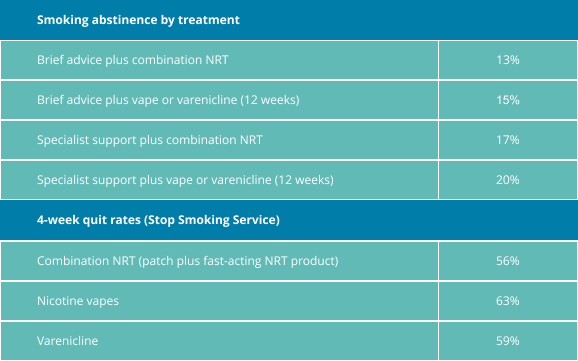
For example, the NSCST “Local Stop Smoking Services and support: commissioning, delivery and monitoring guidance” (April 2024) provides the following estimates for other treatments, with different types of support and at different time periods1:
CYTISINICLINE (given as a 25-day treatment course) has been shown:
- In an open-label trial, to be superior to combination NRT; CYTISINICLINE was associated with a higher frequency of self-reported adverse events (Walker et al 2014)2 For more information click here
- Was inferior to varenicline given for 84 days; CYTISINICLINE was associated with lower frequency of adverse events (Courtney et al 2021, Oreskovic et al 2023)3,4
1. NCSCT. https://www.ncsct.co.uk/publications/commissioning-delivery-monitoring Accessed Jan 2025
2. Walker N et al. N Engl J Med 2014;371:2353-62
3. Courtney RJ et al. JAMA 2021 326(1)56-64
4. Oreskovic T et al. Nicotine Tob Res. 2023 Aug 19;25(9):1547-1555.
Can CYTISINICLINE be used to help stop vaping?
CYTISINICLINE is indicted for smoking cessation and reduction of nicotine cravings in smokers who are willing to stop smoking; the treatment goal of CYTISINICLINE is the permanent cessation of the nicotine containing products use.
The CYTISINICLINE clinical trials did not include people that used e-cigarettes or vapes, and therefore use in this population cannot be recommended.
Can NRT and CYTISINICLINE be used concurrently?
The concurrent use of CYTISINICLINE and Nicotine Replacement Therapy (NRT) is not specifically addressed in the CYTISINICLINE Summary of Product Characteristics (SPC) and a search of the published literature did not reveal clinical studies trialling the simultaneous use of both treatments.
The SPC does advise that: “Smoking should be stopped no later than on the 5th day of treatment. Smoking should not be continued during treatment as this may aggravate adverse reactions. Patient should be aware, that the simultaneous administration of the drug and smoking or use of products containing nicotine could lead to aggravated adverse reactions of nicotine.”
Therefore, the use of NRT would not be recommended after day 5 of treatment with CYTISINICLINE.
Can you use vapes / e-cigarettes with CYTISINICLINE?
This is not specifically addressed in the CYTISINICLINE SPC, however, it does advise that: “Smoking should be stopped no later than on the 5th day of treatment. Smoking should not be continued during treatment as this may aggravate adverse reactions. Patients should be aware, that the simultaneous administration of the drug and smoking or use of products containing nicotine could lead to aggravated adverse reactions of nicotine.”
The concurrent use of vapes / e-cigarettes with CYTISINICLINE would therefore not be recommended.
Can a patient continue with CYTISINICLINE after 25 days if they still have cravings?
The SPC does not allow for patients to continue treatment beyond 25 days. The CYTISINICLINE SPC does state that, in case of treatment failure, the treatment should be discontinued and may be resumed after 2 to 3 months.
The management of a patient after they have completed treatment with CYTISINICLINE remains a clinical decision for the healthcare professional in discussion with the patient.
What if a patient forgets to take a tablet?
The Patient Information Leaflet (PIL) advises that patients should “not take a double dose to make up for a forgotten dose”. A PIL is provided, in each pack of CYTISINICLINE.
